Discover when you need a speaker cable splitter and why it matters for your hi-fi setup. Learn key technical factors and future trends in audio connectors.
When Do You Actually Need a Speaker Cable Splitter — and Why Does It Matter?
Multi-room audio setups and bi-wired speaker systems have made the right speaker cable splitter an essential component for modern hi-fi configurations. Whether you’re running one amplifier to drive two pairs of speakers or setting up a bi-wiring arrangement for better frequency separation, a well-engineered splitter does more than simply divide a signal path. It preserves electrical integrity while keeping the installation visually clean and organized. Without the right component, even a capable amplifier can deliver compromised sound through poor contact points or mismatched connectors.
The importance of split junctions is often underestimated — many audiophiles focus on amplifiers and cables while overlooking the connectors between them. A poorly constructed junction introduces contact resistance and oxidation over time, both of which degrade audio performance in measurable ways. By contrast, a precisely housed splitter with matched cable dimensions maintains consistent signal flow across the entire chain. This is especially critical in bi-wiring setups, where separate cable runs carry high- and low-frequency signals independently to a single speaker’s crossover.
How Kácsa Audió Helps You Find the Right Speaker Cable Splitter for Your Setup
Kácsa Audió approaches cable system building differently from a conventional retailer — the company assembles, tests, and actively guides customers through the selection process. One of their more practical policies is the option to audition assembled cables at home before committing to purchase, which carries real value in a category where subjective listening matters. Their recommendations draw on hands-on testing and accumulated customer feedback rather than off-the-shelf product specs. This level of involvement is particularly useful when selecting splitters, where cable diameter, material grade, and housing fit all need to align precisely.
The product range covers splitters designed for specific loudspeaker cable families — from options sized for 2.5 mm² cables up to models accommodating 6.0 mm² cross-sections, including four-conductor variants built for bi-wiring setups. Each metal-housed model is dimensioned to match the outer diameter of its corresponding cable, ensuring both a secure mechanical connection and a professional finish. The lineup doesn’t offer generic, one-size-fits-all solutions; every splitter is engineered as part of a cable system rather than a standalone accessory. This pairing-by-design approach reflects a broader philosophy that every component in the signal path deserves the same level of engineering attention.
Choosing the Best Speaker Cable Splitter: Key Technical Factors Every Audiophile Should Know
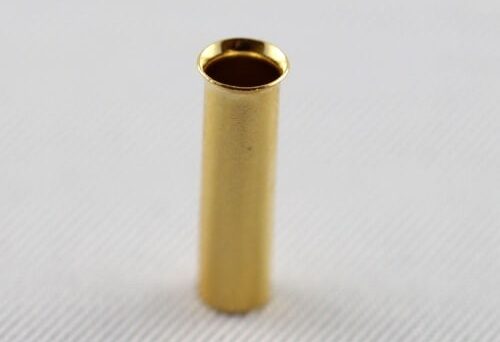
Selecting the right speaker cable splitter starts with cross-sectional area — a mismatch between cable gauge and splitter bore creates turbulence in the conductor path and risks unreliable contact. Standard conductor cross-sections in speaker cable systems typically range from 2.5 mm² to 6.0 mm², and the splitter’s internal diameter must correspond precisely to the cable’s outer jacket. Material quality matters equally: gold-plated copper resists oxidation far better than bare copper or aluminium alternatives, which is why it remains the material of choice in premium assemblies. Some manufacturers, including Furutech, apply cryogenic and demagnetizing treatment to their components — a process that refines the metal’s molecular structure and reduces electromagnetic interference at the contact point.
Compatibility between cable and splitter housing is equally important from a mechanical standpoint. A splitter that fits too loosely allows micro-movement at the junction, introducing intermittent contact and potential signal degradation over time. The outer diameter spec — 13.5 mm for a 2.5 mm² system or 18.5 mm for a 6.0 mm² setup, for example — is not a cosmetic detail but a functional parameter. Before selecting any splitter, confirm both the conductor cross-section and the cable jacket’s outer diameter, and verify that ferrule sizing at the wire terminations matches throughout.
Future Trends in Speaker Cable Splitting: What Hi-Fi Enthusiasts Should Watch Out For
Material science is reshaping what’s possible in audio connectors, and the effects are already visible in splitter design. Cryogenic treatment — applied at temperatures approaching −196°C — alters the grain structure of conductive metals, reducing internal resistance and improving signal transmission consistency. While this process was once limited to boutique manufacturers, it’s increasingly appearing across broader product lines, making it a meaningful specification to evaluate rather than an exotic premium. Alongside this, the use of non-magnetic metals in housing construction is gaining traction, as magnetic interference from connector bodies can affect signal clarity in sensitive systems.
Customization is emerging as another defining direction in this space. A speaker cable splitter chosen as part of a complete cable assembly — rather than sourced separately — tends to deliver more predictable results by eliminating the guesswork around impedance and mechanical compatibility. Modular cable systems, where the splitter, cable, and termination are specified together from the outset, are increasingly preferred by audiophiles building or upgrading a system with long-term performance in mind.